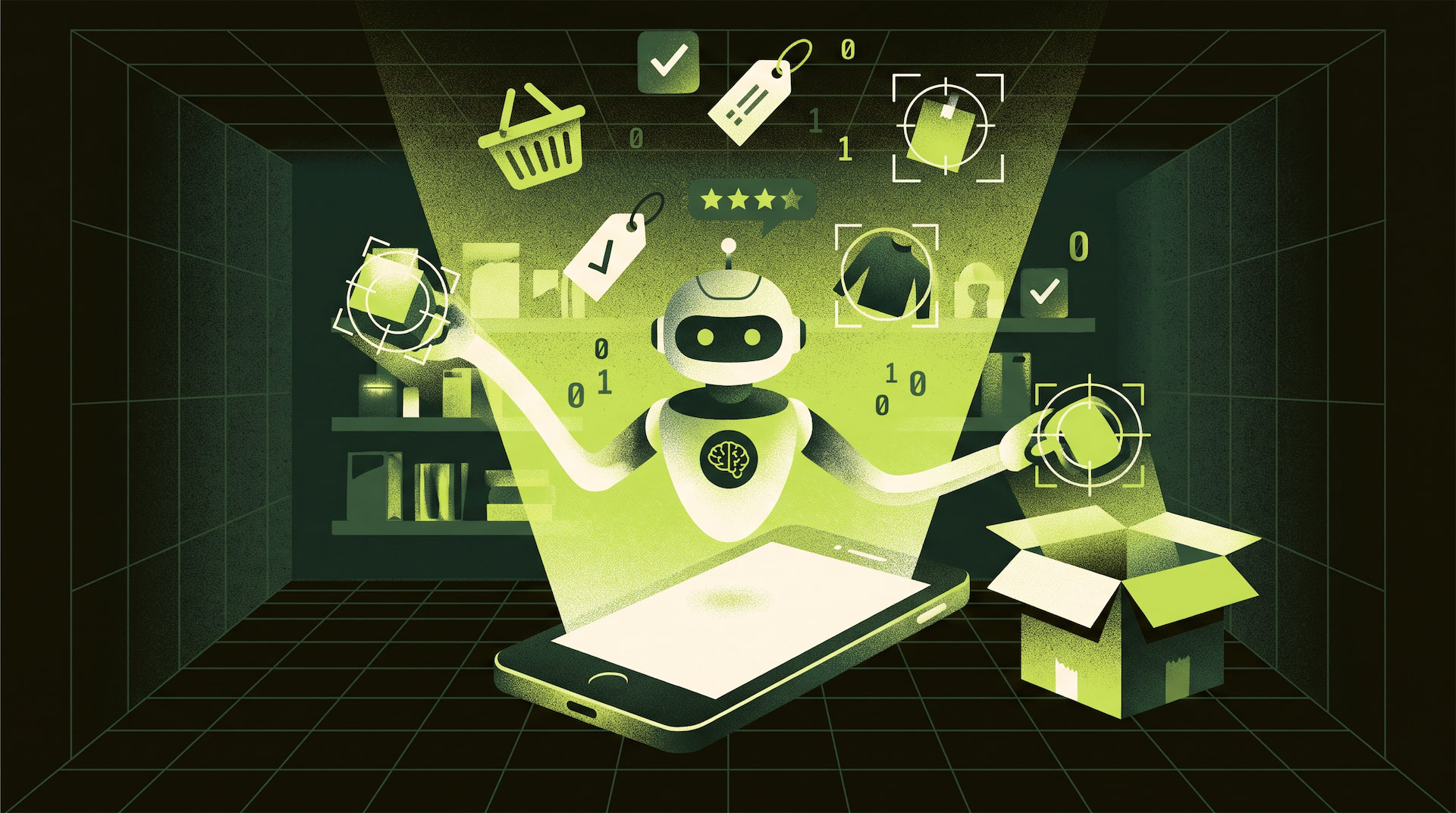
Open the file /agents.md on almost any Shopify store today and you’ll find something new: a page written not for people, but for AI. It explains to an assistant how to search the store’s products, build a cart and hand the shopper a checkout. Most store owners have never seen it. Shopify publishes it for them.
That small file says a lot about where shopping is going. A growing share of shoppers start with an assistant: “find me a linen dress for a summer wedding, under $150”. The assistant does the searching. Your store’s job is no longer only to be found by a person. It’s to be understood by a machine that is choosing on that person’s behalf.
Key takeaways
- AI-referred visits to US retail sites grew 138% in a year, and now convert better than other traffic, according to Adobe.
- Shopify stores already expose agent-facing files and a shopping protocol (UCP) that let assistants search the catalog and build carts.
- Assistants pick products from structured data: titles, attributes, variants, price, stock and policies.
- The fix is the same one that makes your own search work: product data that answers the questions shoppers actually ask.
The numbers: small channel, fast growth, high intent
Adobe, which measures traffic across more than a trillion visits to US retail sites, reported in June 2026 that traffic arriving from AI assistants grew 138% year over year in May, and has grown more than fourteenfold since it started tracking the channel in October 2024. The more surprising number is quality: in May 2026 those visitors converted 54% better than visitors from other sources, a reversal from 2025, when they converted at roughly half the rate. They also stayed 53% longer and viewed 23% more pages.
It’s still a small slice of total traffic. But a shopper who arrives after an assistant has already compared options is a shopper who has mostly decided. That’s why the arrival matters more than the volume.
What an AI agent actually sees in your store
On October 28, 2026 we looked at what a large Shopify brand serves to machines. Three files stood out:
/sitemap_agentic_discovery.xml, a sitemap with a single entry: the store’sagents.md, refreshed weekly./agents.md, plain instructions for assistants: how to discover products, manage carts and prepare checkout, and the rules, such as placing an order only with the buyer’s approval and identifying agent traffic./.well-known/ucp, a machine-readable profile for the Universal Commerce Protocol, listing what the store supports: catalog, cart, checkout, discounts, fulfillment.
UCP is an open standard Google announced in January 2026 together with Shopify, with Etsy, Wayfair, Target and Walmart among its backers. Shopify’s agent documentation describes what it enables: assistants can search products across every Shopify merchant through a Global Catalog, or within one store through a Storefront Catalog, then build a cart over several turns of conversation and pass the shopper a checkout.
In other words: an assistant isn’t only reading your homepage. It’s running searches against your catalog.
The same request, two kinds of product data
linen, for a wedding, under $150White linen midi dressmaterial, occasion and price are in the data
linen, for a wedding, under $150Nothing to matchtitle says “Style 4471, ivory”
How assistants choose: products first, then sellers
OpenAI’s help page for shopping in ChatGPT describes two separate decisions. First, which products fit: chosen from the shopper’s request and context and from structured product data supplied by merchants and third-party providers, independently of ads. Then, when several sellers offer the same item, which seller to show, weighing availability, price, quality and whether the seller is the maker or primary seller.
Both decisions run on data, not on design. A beautiful product page doesn’t help if the assistant can’t tell what the product is made of, who it’s for, whether it’s in stock in the right size, or how long delivery takes.
What gets a store picked
The good news: none of this needs a new marketing budget. It needs the same work that makes your own search box useful.
- Say what the product is, in plain words. Material, fit, occasion, size range, who it’s for. “Ivory dress, style 4471” gives an assistant nothing to match. “Ivory linen midi dress, breathable, for summer events” gives it four reasons.
- Fill in the attributes, not only the description. Variants, sizes, colours and materials as structured fields. Agents filter by them the way a shopper filters by “size M, under $150”.
- Keep price and stock accurate. When assistants compare sellers, an out-of-date price or a size that’s actually sold out costs you the pick.
- Write your policies as answers. Shipping times, returns, exchanges, sizing. Agents read these pages to answer “can I return it?” before recommending you. A clear answer is a reason to choose your store.
- Don’t block the machines you want. Check that your robots rules and bot protection don’t shut out the assistants your shoppers use. Shopify’s own instructions ask agents to identify themselves, which lets you tell good bots from bad ones.
- Learn the questions from your own shoppers. The way people type to an assistant is the way they’re starting to type into your search box: whole sentences, needs instead of product names. Your search log, especially the searches that found nothing, is the best preview you have.
Two search boxes, one answer
For years, store search was a box at the top of the page, used by people. Now there are two: yours, and the assistant’s. They ask the same kind of question, in the same kind of language, and they fail for the same reason: product data that describes items the way the warehouse sees them, not the way shoppers think about them.
Fix that once, and both get better. Your shoppers find what they mean, and the assistants that shop for them can finally recommend you.
Frequently asked questions
Can ChatGPT or Gemini really buy from my store?
They can search your products and prepare a cart and checkout. Shopify’s rules for agents say an order is placed only with the buyer’s authorization, and the shopper typically confirms on your checkout page.
Do I need to set anything up on Shopify?
Shopify generates the agent-facing files and the UCP profile for stores on its platform. What it can’t do for you is make your product data complete and clear, and that’s what decides whether you’re picked. For the search shoppers use on your own site, see Shopify search, explained.
What is agents.md?
A plain-text file at the root of a store that explains to AI assistants how to browse and shop it: which tools to use, how checkout works and which rules to follow. It’s the AI equivalent of a store guide.
Does AI traffic convert?
According to Adobe’s May 2026 data, visits referred by AI assistants to US retail sites converted 54% better than other traffic. A year earlier they converted at about half the rate, so the picture is changing fast.
Sources
- Adobe: AI-referred traffic to retail sites doubles in a year, Digital Commerce 360, June 2026
- Shopping with ChatGPT search, OpenAI Help Center
- Universal Commerce Protocol, Shopify
- Building agents for commerce, Shopify developer documentation
- Universal Commerce Protocol specification, ucp.dev

Back-end engineer and AI specialist who thinks in vectors and dreams in latency budgets. Aviad builds the engine under Lets: the indexes, the embeddings, the AI answers and the systems that keep them fast and secure. If a query takes longer than a blink, he takes it personally.
See it on your store.
Leave your details and we'll set Lets up on your catalog. Typos, questions and photos, answered from your own products. 30-day money-back guarantee.
You're in. We'll email you shortly with how to set Lets up on your store.